Can You Bring Edibles to Saudi Arabia? CBD & Hemp Laws for Travelers (2026)
Can You Bring Edibles to Saudi Arabia? CBD & Hemp Laws for Travelers (2026)
No. You cannot bring hemp edibles, CBD gummies, cannabis-infused products, or any cannabis-derived substance into Saudi Arabia — full stop. This isn’t a gray area, a loophole story, or a “depends on the product” situation. Saudi Arabia’s 2003 Narcotics Control Law classifies all cannabis derivatives as controlled narcotics, makes no legal distinction between hemp-derived CBD and recreational marijuana, and enforces that position with some of the harshest drug penalties on Earth. Imprisonment, flogging, and death are all on the table, depending on quantity and intent.
If you’re a U.S. traveler used to the TSA’s 0.3%-by-dry-weight hemp framework, or a European used to CBD being a wellness product, Saudi Arabia will catch you off guard fast. That “federally legal” Certificate of Analysis in your bag means nothing at King Khalid International Airport.
Key Takeaways
- All cannabis-derived products — including hemp CBD — are illegal in Saudi Arabia with zero exceptions (Anti-Narcotics General Directorate, 2026).
- Saudi customs does not distinguish between hemp-derived CBD and marijuana. If it’s from the cannabis plant, it’s a narcotic under Saudi law.
- Penalties range from 6 months imprisonment for personal possession up to the death penalty for trafficking (Saudi Ministry of Interior).
- As of November 1, 2025, even many prescription medications require advance SFDA clearance — the bar for scrutiny at Saudi airports has risen, not fallen.
- No approved medical cannabis or hemp program exists in the Kingdom. There is no legal pathway for CBD consumer products.
Can You Bring Edibles to Saudi Arabia? Key Rules to Keep in Mind:
Before you pack, be sure to review the official guidance on Saudi Arabia Airport Customs Rules to ensure you do not inadvertently carry banned substances.
If you have legal prescription medications you need to bring with you, do you want me to help you find the guidelines on how to declare them or what documentation you need from your doctor before you fly?
What Does Saudi Law Actually Say About Cannabis and Hemp?
Saudi Arabia’s Anti-Narcotics General Directorate operates under the Narcotics Control Law, enacted by Royal Order No. 4/B/966. The law is blunt: cannabis in any form is a narcotic substance. Unlike U.S. or EU frameworks that carve out a legal distinction for low-THC hemp, Saudi legislation treats the entire cannabis plant — every derivative, every cannabinoid, every concentration — as prohibited.
That means CBD oil, hemp gummies, delta-8 THC products, THCA flower, and full-spectrum tinctures all fall into the same legal bucket as high-THC marijuana. Customs officials at Riyadh’s King Khalid International Airport (RUH), Jeddah’s King Abdulaziz International Airport (JED), and Dammam’s King Fahd International Airport (DMM) are not testing for THC percentage thresholds. They’re not calibrating their response based on whether your gummies contain 0.3% or 30% delta-9. The product derives from cannabis. That’s enough.
Can You Bring Edibles to Saudi Arabia? What Are the Actual Penalties?
The Saudi Ministry of Interior’s narcotics enforcement tier looks like this:
Personal use / possession: Up to 6 months imprisonment, with the possibility of whipping for first offenses. Repeat offenders face escalating sentences.
Dealing: Up to 10 years imprisonment, plus whipping.
Smuggling / trafficking: The severest tier. Saudi law treats anyone who imports narcotics from abroad as a smuggler — including travelers who receive and distribute substances to others. The penalty for smuggling narcotics into the Kingdom is death. Saudi authorities have executed foreign nationals under this statute.
The critical point for travelers is definitional: bringing edibles through customs into Saudi Arabia is classified as importation. You are not a casual user with a personal stash. You are someone who moved a controlled substance across an international border into the Kingdom. Saudi prosecutors and courts have interpreted this broadly.
According to the Saudi Ministry of Interior’s published narcotics guidelines, the law differentiates between smugglers, dealers, and users — but that distinction offers little comfort when a tourist gummy bears arrest looks identical to importation on paper.
Has Saudi Arabia Prosecuted Foreigners for CBD Products?
Yes, and this is where travelers most frequently underestimate the risk. Saudi authorities have prosecuted foreign nationals for possession of small quantities of CBD products purchased legally in their home countries. The argument “I didn’t know it was illegal” carries no legal weight. Neither does “it’s just CBD” or “it was federally legal where I bought it.”
The practical reality at Saudi borders, as documented by cannabisregulations.ai (May 2026): customs officials do not test for THC content and calibrate penalties based on a 0.3% threshold. If a product is derived from cannabis — which all CBD products are — it may be treated as a dangerous drug. The label saying “hemp-derived” or “THC-free” is actually a liability, not protection, because it openly identifies the product’s botanical origin.
Foreign embassies are relatively limited in their ability to intervene in drug cases. As Expatica’s Saudi Arabia legal guide notes, authorities make no exceptions and consular access doesn’t translate into drug charge dismissal.
What Changed at Saudi Airports in 2025 and 2026?
Two shifts are worth knowing about, because they signal the direction Saudi Arabia is heading with border enforcement.
November 1, 2025 — SFDA controlled medication clearance mandate. Effective November 1, 2025, all travelers arriving in or departing from Saudi Arabia who carry medications containing narcotic or psychotropic substances must obtain advance clearance through the Saudi Food and Drug Authority’s Controlled Drugs System (CDS) platform. This applies to common prescription drugs like Xanax, Adderall, Valium, and Tramadol. The U.S. Embassy issued a Health Alert confirming the requirement. Travelers who arrive without electronic SFDA clearance risk having their medication treated as an illegal substance, which can result in arrest rather than a polite confiscation.
This matters for cannabis travelers not because CBD can be cleared through CDS — it can’t; there’s no legal pathway for cannabis derivatives — but because it signals a broader tightening of border pharmaceutical scrutiny. Airport inspections are getting more systematic, not more relaxed.
2026 — Intensified crackdown on synthetic drugs and poppy seeds. As of 2026, Saudi customs has extended zero-tolerance enforcement to synthetic drugs and even food items containing poppy seeds, classifying them under narcotic substances. If poppy seeds in a bread roll get flagged, your hemp gummies won’t survive a bag check.
Why “TSA-Compliant” Means Nothing at Saudi Customs
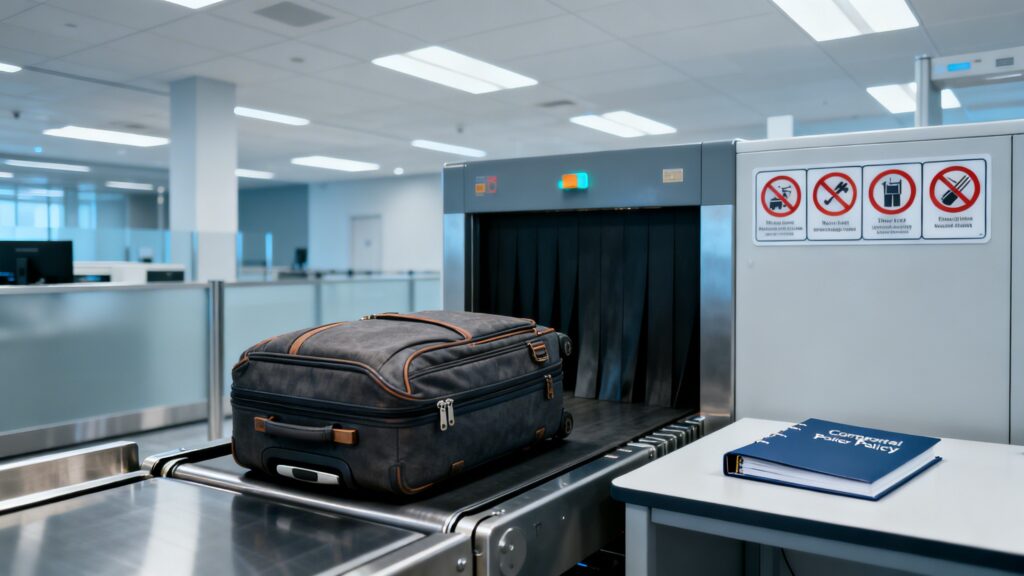
U.S. travelers who’ve flown domestically with hemp edibles sometimes arrive in Saudi Arabia thinking their TSA clearance experience translates. It doesn’t. Here’s why the two systems are fundamentally incompatible:
TSA operates under federal U.S. law, which recognizes hemp (under 0.3% delta-9 THC by dry weight) as a non-controlled agricultural commodity under the 2018 Farm Bill. TSA officers aren’t drug enforcement agents — they’re looking for explosives and weapons. If they happen to find your hemp gummies, they may refer to local law enforcement, who then applies the relevant U.S. state law.
Saudi customs operates under Islamic law-influenced narcotics legislation that treats cannabis as a Schedule I equivalent with no exceptions. Saudi customs is drug enforcement. They’re actively looking for prohibited substances, and their detection methods have become more sophisticated over time. “THC-free” isn’t a legal category that Saudi law recognizes.
The U.S. hemp law changes on November 12, 2026 — when a new federal standard replaces the percentage-based hemp definition with a 0.4 mg total-THC-per-container cap — are entirely irrelevant to Saudi law. No version of U.S. hemp regulation creates any permissible status for these products at a Saudi border crossing.
What Should You Do If You’re Traveling to Saudi Arabia?
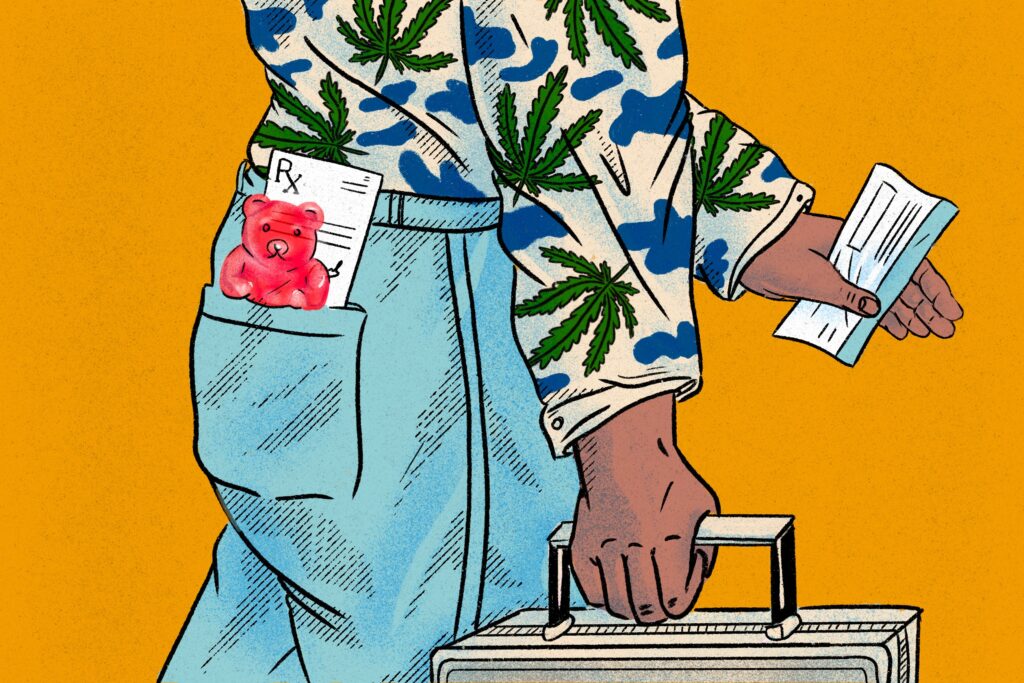
The answer is straightforward: leave all cannabis-derived products at home. Every one of them. That includes:
- CBD oil tinctures and capsules
- Hemp gummies and delta-9 edibles
- Full-spectrum or broad-spectrum CBD products
- Delta-8 or delta-10 THC products
- THCA products, hemp flower, or pre-rolls
- Cannabis-infused beverages, chocolates, or snacks
- Topicals and creams labeled as CBD or hemp-derived
Don’t assume that decanting products into an unmarked container helps. Saudi customs can and does conduct chemical testing when products look suspicious. Don’t assume that checking luggage reduces scrutiny — Saudi customs inspects checked bags. Don’t assume that a brief layover or transit constitutes lower risk — Saudi law applies at all ports of entry, including during transit.
If you carry prescription medications, use the SFDA’s Controlled Drugs System to obtain clearance before you travel. Submit your application at least two to three weeks before departure, per SFDA guidance, to allow time for additional documentation requests. The required submissions include a valid prescription, a medical report from your doctor, proof of identity, and detailed information about each controlled medicine.
Can You Bring Edibles to Saudi Arabia?
What About Transit Through Saudi Arabia?
Saudi law applies at all ports of entry, including transit zones. Travelers transiting through Riyadh or Jeddah en route to another destination are subject to Saudi customs jurisdiction during that transit. If a bag check occurs during transit and cannabis-derived products are found, Saudi law governs the outcome — not the laws of your origin or destination country.
This is a meaningful distinction for travelers routing through Saudi hubs (Riyadh’s RUH and Jeddah’s JED are major regional connectors) from cannabis-legal countries like Canada, the Netherlands, or U.S. states with adult-use programs.
Checklist Before Traveling to Saudi Arabia
SAUDI ARABIA TRAVEL — PROHIBITED SUBSTANCE CHECKLIST

✅ Remove ALL cannabis-derived products from luggage (both carry-on and checked)
✅ Remove ALL hemp-labeled products regardless of THC content
✅ Remove CBD topicals, tinctures, gummies, and edibles
✅ Obtain SFDA Controlled Drug System clearance for any controlled prescription medications
✅ Apply for SFDA clearance 2–3 weeks before departure
✅ Keep all permitted medications in original pharmacy packaging with prescription labels
✅ Do NOT rely on COAs, hemp-derived labeling, or U.S. TSA compliance as legal shields
✅ If transiting through Saudi Arabia, apply the same rules
Frequently Asked Questions about Can You Bring Edibles to Saudi Arabia?
Can you bring CBD to Saudi Arabia?
No. CBD is illegal in Saudi Arabia regardless of its source (hemp or marijuana), THC content, or legal status in your home country. Saudi law does not distinguish between hemp-derived CBD and other cannabis derivatives. All cannabis products are classified as narcotics.
What happens if Saudi customs finds hemp edibles in my bag?
Outcomes range from confiscation and deportation to criminal charges and imprisonment, depending on quantity and how authorities interpret the product. Bringing cannabis-derived substances across the Saudi border is classified as importation of narcotics. Penalties are severe, and foreign embassies have limited ability to intervene.
Can I bring CBD gummies in my checked luggage to Saudi Arabia?
No. The same prohibitions apply to checked luggage. Saudi customs inspects checked bags and applies the same narcotics law regardless of whether the product is in your carry-on or hold luggage.
Is medical marijuana allowed in Saudi Arabia?
No. Saudi Arabia has no approved medical cannabis program. Medical marijuana cards, prescriptions, and letters from foreign physicians provide no legal protection in Saudi Arabia. Cannabis remains a prohibited narcotic in all use cases.
Can I transit through Saudi Arabia with hemp products?
No. Saudi law applies in all transit zones at Saudi airports. Travelers passing through Riyadh (RUH) or Jeddah (JED) are subject to Saudi customs authority during transit.
My CBD product is “THC-free” — does that matter in Saudi Arabia?
No. Saudi law does not recognize a THC-free exception for cannabis-derived products. If the product originates from the cannabis plant, it can be treated as a narcotic regardless of cannabinoid content or concentration.
What prescription medications require SFDA clearance for Saudi travel?
As of November 1, 2025, travelers must obtain advance clearance from the SFDA for medications containing narcotic or psychotropic substances, including common prescriptions like Xanax, Adderall, Tramadol, and Valium. Applications go through the SFDA’s Controlled Drugs System (CDS) platform. Submit at least two to three weeks before travel.
Are the penalties really as severe as reported?
Yes. The Saudi Ministry of Interior’s published narcotics guidelines confirm that smuggling narcotics into the Kingdom carries the death penalty. Personal possession carries up to 6 months imprisonment for first offenses, with escalating penalties for repeat offenses. Saudi courts have applied these penalties to foreign nationals.
This article is for informational purposes only and does not constitute legal advice. Saudi Arabia’s narcotics laws are subject to change, and enforcement practices evolve. Verify current rules with official Saudi government sources and qualified legal counsel before traveling.